
The REVAMP Framework for Asking Deeper Questions
Why the best follow-up question isn't the obvious one

Earlier this week, I had the privilege of leading a 1-hour session on how to build trust and vulnerability in working groups.
The participants were council leaders for Never Search Alone, an organization that helps people ready for a career change find community and insight for their search. (More on this remarkable organization in the “bonus” section below.)
Our conversation centered around a theme that you may remember from my TEDx Talk: We can’t just ask questions for facts; we have to ask questions for understanding.
Understanding questions go deeper than the facts to engage with feelings and motivations—the “why” of who we are and what we’re really thinking.
Getting to that deeper layer of what is happening beyond just the facts is essential. Without it, we miss truly understanding the people we care about most. And in our professional lives, such as with the leaders of these job search councils, when we don’t ask questions for understanding we risk focusing on the small stuff instead of the problems or worries or possibilities that lie at the deeper level.
Here are some examples I offered for the job search context:
Imagine a council member, who has been laid off and is searching for work, says, “This week I wrote my favorite old boss to see if we could have lunch, and she said she was too busy this month.”
As the group leader, you could focus on the facts and move back to the next steps in your process. “So who will you reach out to next?”
But that response will leave the council member’s feelings unresolved and likely ignores the concerns that lay beneath the surface. A more powerful, understanding-seeking next question might be, “What is the meaning you’re making of her response?”
See the difference in that question? By asking about the meaning of the experience, we can surface the emotional layer that reflects what is really going on inside the council member’s head. You’ll see these same layers again in the REVAMP framework below.
Or another example—Imagine Tom, who is fed up with his current job, reports that he feels tempted to apply to every job he sees, but he knows that isn’t a strategic choice. A good facilitator might ask something like, “What’s motivating that desire?” Or, “What do you want to prioritize right now?”
REVAMPING your questions
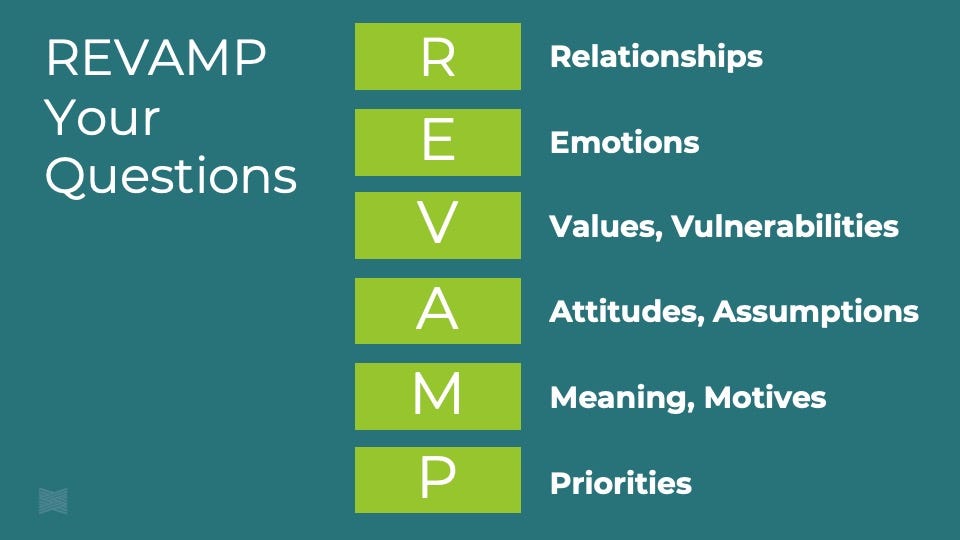
Those alternative questions above have been revamped. We revamp a question when we move beyond facts to focus on what’s happening beneath the surface. REVAMP is an acronym to help you remember to deepen your questions by asking about these things:
R – Relationships
E – Emotions
V – Values or Vulnerabilities
A – Attitudes or Assumptions
M – Meaning or Motives
P — Priorities
The examples above asked about meaning, motivation, and priorities. Here, let’s look at a question that digs into relationship: Imagine your partner is sharing about a tense work meeting where he observed two colleagues in conflict. Instead of asking, “Then what did Megan say?,” you might go a layer deeper by asking about the relationship between Megan and the colleague she was in conflict with. “What’s the dynamic between Megan and Paul, and how do you fit into it?”
You could also ask, “Does their dynamic threaten your team?”—a question about vulnerabilities.
Or if your aunt is giving you a movie recommendation, you could ask, “Who is in that movie?,” but a Google search would answer that. You’ll understand your aunt better if you ask, “What was it about the movie that spoke to you?” That question gets at values and attitudes, maybe evening meaning or priorities.
None of this takes much extra time or training—you know everything you need to put REVAMPed questions into practice right now. What you do need is intention—the intentional commitment to seek understanding in conversations that matter.
How can you REVAMP your questions?
I love a good multi-step process, but there isn’t one needed here. To REVAMP your questions, all you have to do is try.
Not long ago, I was at lunch with a friend of mine. We don’t get to talk regularly, so we caught up on our families and work lives. We could have kept it at the surface level—how’s the new grandbaby? But I think we both value our conversations because they go deeper. So after we shared the general status updates, we discussed how these things make us feel and what they make us think. Our questions were in the territory of relationships and emotions and priorities; in other words, they were REVAMPed.
All you have to do is remember to ask a deeper question.
REVAMPing your questions offers the gift of understanding; we know each other better. We feel seen and heard in meaningful ways, when others ask these questions of us. And these kind of questions give us the opportunity to really process our own experience, and support others as they do the same.

BONUS CONTENT
Let me share a little more about Never Search Alone, the organization I mentioned at the start of this article. This is a movement of 5,000 volunteers that has helped over 50,000 job seekers through 6,200 job search councils (JSC)..
Through the organization, you can join a free JSC, which are peer support groups for people who are seeking work. Council members work through tools to help seekers find the right fit for the market (“candidate-market fit”) and improve their search process.
I’ve been on the sidelines of Never Search Alone for a few years now, and have just started volunteering as a trainer for the council moderators. Some things in life are too good to be true—this isn’t one of them. Take my word for it … this is a truly free opportunity to offer support for people in the job search process. The only related cost is if you decide to purchase the corresponding book, also called Never Search Alone; every dollar from the sales is donated to run the community.
If you’ve been laid off, let go, or are looking for your next job, take some time to see if it might be a good community for you: https://www.neversearchalone.org/about.
BONUS NOTE
When I originally sought a memory device to help recall the ways we could deepen questions, the first acronym I tried was VAMPIRE. Some trusted advisors wisely cautioned me to find a different option. I think they were right, but I still laugh when I think my tagline could have been “VAMPIRE: draw blood with your questions.”
I'm fascinated by questions too. Curiosity and it's use as a leader are a big part of my writing and work: "...move beyond facts to focus on what’s happening beneath the surface." I really like the framing - thanks